A Living Dedication · Active Investigation

MADABA

مادبا — The City of Mosaics
3,200 Years · Three Christian Families · Where the Map Was Found
31.7167° N · 35.7944° E · al-Madaba, Hashemite Kingdom of Jordan
Dedicated, with love and reverence, to Leila Karadsheh Gharib
§ 01 · The Question

What is at 31.72° N, 35.79° E?

ما هي مدينة الفسيفساء؟

Thirty-eight kilometers south of Amman, on a high tableland east of the Dead Sea, sits a town the Amorites named in the second millennium before Christ. The Moabites took it. The Romans renamed the province around it. The Byzantines tiled its floors with maps of a world that no longer exists. An earthquake at four o'clock in the afternoon on the eighteenth of January, AD 746, tipped its churches into ruin and emptied its streets for eleven hundred years.

In 1880, three Christian families walked north from Karak with their belongings and their priests and resettled the ruins. They called the empty quadrants of the destroyed town Hais — neighborhoods — and divided the land in three. The northwest quadrant became the Karadsheh Hai. Within four years, while building a new church on the foundations of an old one, they uncovered the most important Christian artifact in Jordan.

This is the place. This is the lineage. This is where Leila comes from.

§ 02 · The Mosaic Map

The Church of the Map

كنيسة القديس جورجيوس · St. George's Greek Orthodox

When the resettling families began constructing their Greek Orthodox church on a Byzantine foundation, the workers — almost certainly including Karadsheh hands — uncovered a mosaic floor that had been buried since the eighth century. Two million colored tesserae of stone and glass, originally fifteen to twenty-five meters long and six meters wide, formed the oldest surviving cartographic depiction of the Holy Land in existence.

It is called the Madaba Mosaic Map. It dates to AD 560. It shows Jerusalem at its center, drawn out of proportion with everything around it because Jerusalem was out of proportion with everything around it. It labels 157 sites in Greek, from Egypt to Lebanon, with the Jordan River drawn in cool blue and fish swimming downstream into the Dead Sea. It is older than the prophet's hijra. It is older than the Vatican as we know it. It is, in the most literal possible sense, the foundation Leila's ancestors prayed on.

Per the Karadsheh tribal record: "The Karadsheh and Maayah families worshiped at the Greek Orthodox Church." For four generations before Leila was born in Wyandotte, her people stood on top of the Madaba Map every Sunday and called it home.

Leila's grandparents walked the mosaic. Her great-grandparents walked the mosaic. Her great-great-grandparents helped uncover it. Inheritance is sometimes a building. Sometimes it is what is buried under the building. Here it is both.
§ 03 · Three Families · Three Hais

The 1880 Resettlement

كرادشة · عزيزات · معايعة

For 1,134 years after the earthquake of 746, Madaba was empty. The bedouin tribes around it — the Bani Hamida, the Bani Sakhr — used the ruins as winter pasture. In 1880, after a deadly conflict with the dominant Karak clans drove them north, three Christian families negotiated with the Ottoman authorities for permission to resettle the ancient town: Karadsheh, Azeizat, and Maayah.

They divided Madaba into three Hais — quadrants — and each family took one. The Karadsheh Hai sits in the northwest, with several large underground caves the tribe used as the original household structures, building their first stone homes around them. Each family farmed the lands beyond their gate. Each family built their parish where they had always worshipped: the Karadsheh and Maayah at the Greek Orthodox church (where the Map would be found), the Azeizat at the Latin Catholic church next door.

The Karadsheh trace their line further still. Before Karak, the family lived in Salkhat in the Hooran, in what is now southern Syria, beginning around 1605. The patriarch Salameh Al Karadsheh (1675–1754) settled the family in Karak. His grandson's line, two centuries later, would walk to Madaba and start over.

Within the founding tribal complex, intermarriage between sub-branches was the norm. The Karadsheh's many lines — Almarzook, Aljumian, Alfarhood, Alqossoos, and others — wove themselves together across generations through routine endogamy. Both of Leila's grandfathers' families belong to this complex: Marzouk through the Almarzook line, Jumean through the Aljumian line. Both descend from the same patriarch Jaber Karadsheh (1705–1784). Marzouk and George were 4th cousins once removed — distant by blood, neighbors by Hai.

Resettled
1880
Three families from Karak
Karadsheh Hai
Northwest
Underground caves · stone homes
Tradition
Greek Orthodox
Antiochian Patriarchate
Earlier Origin
Salkhat
Hooran region · circa 1605
§ 04 · The King's Order

George Khalil Jumean

جورج خليل جميعان الكرادشة · 1901–1979

Leila's maternal grandfather was a man King Abdullah I personally ordered into uniform.
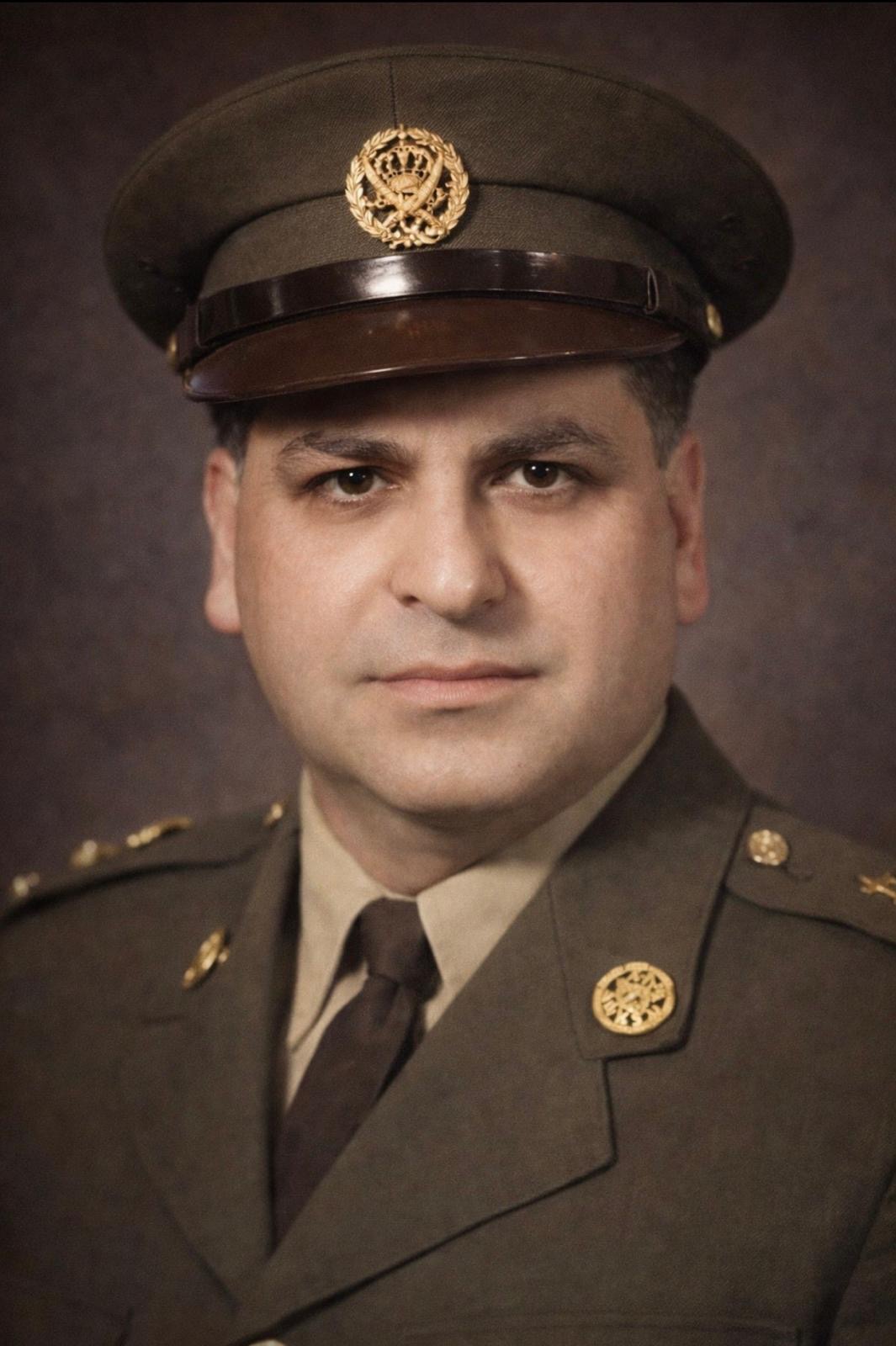
George Khalil Jumean in Royal Jordanian Army officer service dress, with Hashemite royal-crown cap badge.
Col. George Khalil Jumean (Ret.) Royal Jordanian Army · Financial Department

George Khalil Jumean was born in Madaba in 1901 to the Aljumian sub-branch of the Karadsheh tribal complex — a direct descendant, six generations back, of Salameh Al Karadsheh. He was educated first at the CMA school in Madaba, then transferred with family support to the Thompson School in Ein Karem, Palestine, and from there to a British-Palestinian accounting institute in Jerusalem. The Madaba Christian pipeline to administrative service ran through Palestine; George was the pipeline working as designed.

By personal order of King Abdullah I, he was directed to wear military uniform — commissioned initially as Major (رائد), rising in active service to Lieutenant Colonel (مقدم). He served as Assistant Director and Chief Auditor of the Arab Legion / Royal Jordanian Army Financial Department for approximately fifteen years — first under a British director, later under the Jordanian director Issa Qassis. He retired in 1965 with the honorary rank of Colonel (عقيد متقاعد). He died in 1979.

Born1901 · Madaba (family testimony; some tribal sources record 1910)
Died1979
WifeSalwa Nasr · سلوا نصر
CommissionBy order of King Abdullah I · Major
Active RankLieutenant Colonel · مقدم
HonoraryColonel · عقيد متقاعد
RoleAsst. Director & Chief Auditor
DepartmentArmy Financial Department
Retired1965
LineageJaber → Issa → Odeh → Jumian → Khalil → George

He was, in the most literal sense, the man who kept the books of the army that built modern Jordan. For fifteen years, every payroll, every requisition, every pound spent on the formation of the Hashemite Kingdom's military passed under his audit. His son Dr. Hani George Jumean trained at the American University of Beirut and became a physician. His daughter Seham (also spelled Siham) married Marzouk Khalil Marzouk Karadsheh and bore six children in Wyandotte, Michigan. The third of those children, born October 29, 1956, is the woman this page honors.

Marzouk sent the Morse. George kept the books. Both wore the King's uniform. Both were ordered to. Two Legion service lines converged on Leila — neither in the line of fire, both in the architecture.
§ 05 · The Mountain

Mount Nebo

جبل نيبو · The Promised Land Was Visible

Ten kilometers west of Madaba, the land rises to Mount Nebo — the height from which Moses, in the closing chapter of Deuteronomy, saw the promised land he was forbidden to enter. From the summit on a clear day you can see Jericho, the Dead Sea, the hills of Hebron, and on rare mornings the rooftops of Jerusalem itself.

Nebo is not in Madaba. It is visible from Madaba. The relationship matters. For three thousand years the people of this tableland have lived in sight of a mountain that means almost-arrived. They have lived as people who can see where they are going without yet being able to enter it.

The Karadsheh family knew that view for four generations after 1880. Marzouk Karadsheh — Leila's father — saw it as a child, then as an Arab Legion signaller in the Glubb era, and last in 1953, when he boarded a ship for a country none of his ancestors had ever set foot in. Mount Nebo was the last horizon he saw before he became almost-arrived in a different sense entirely.

To leave Madaba is to leave the place from which the promised land was first identified. To return is to remember that promise has a fixed coordinate.
§ 06 · The Crossings

Madaba to Riverview

من مادبا إلى ريفر فيو · Five Cities · Three Generations

The arc of this lineage is geographic before it is anything else. From the high tableland east of the Dead Sea, to the Hashemite capital where the Arab Legion had its headquarters, to a Greek port, to an American island in New York Harbor, to a chemical-works town on the Detroit River, to the small downriver city where Leila now lives. Five cities. Three generations. One unbroken line.

1880
Karadsheh resettlement — Karak → Madaba
The northwest Hai is established. The Greek Orthodox church is begun atop a buried Byzantine foundation.
circa 1884
The Madaba Map is uncovered
Construction workers building St. George's discover the 6th-century Byzantine mosaic. Two million tesserae. The oldest surviving map of the Holy Land.
1901
George Khalil Jumean born — Madaba
Future Chief Auditor of the Army Financial Department. Leila's maternal grandfather. Aljumian sub-branch.
Birth year — pending
Marzouk Khalil Marzouk Karadsheh born — Madaba
Greek Orthodox. Raised in the Madaba Christian community, the same diaspora pipeline that fed the Arab Legion's technical and administrative branches.
circa 1930s
George Jumean commissioned — by personal order of King Abdullah I
Initial rank Major (رائد). Posted to the Arab Legion / Army Financial Department under a British director.
circa 1945–1951
Marzouk — Arab Legion signals service · Amman / Zarqa
Morse code operator under British command in the Glubb Pasha era. The Madaba Christian community supplied disproportionate numbers to the Legion's technical and signals branches.
November 5, 1951
Khalil born — Amman
Marzouk and Seham Jumean's first child. The only sibling born on Jordanian soil. Future internist, University of Belgrade Faculty of Medicine, class of 1974.
1953
Emigration — Jordan → Wyandotte, Michigan
Marzouk, Seham, and infant Khalil emigrate from Jordan to Wyandotte, Michigan, settling on the Detroit River near the chemical works.
1953–1969
Wyandotte Chemical Company employment
Founded as the Michigan Alkali Company in 1890 atop one of the largest underground salt deposits in Michigan. Acquired by BASF in 1969 — at the time the largest U.S. investment ever made by a German company.
November 9, 1954
Sammy born — Wyandotte (1st US-born)
First American child of the line.
October 29, 1956
Leila born — Wyandotte (the daughter)
Third child overall. Second US-born. The only daughter among five sons. The bridge generation.
July 16, 1958
Mike born — Wyandotte
Fourth child.
July 31, 1960
Zaid born — Wyandotte
Fifth child. Carries the family's earliest preserved Arabic given name.
September 17, 1961
Danny (Adnan) born — Wyandotte
Sixth and youngest. Six children in ten years. The household is complete.
1965
George Jumean retires — honorary Colonel (عقيد متقاعد)
Approximately fifteen years as Assistant Director and Chief Auditor of the Army Financial Department concluded.
1979
George Khalil Jumean dies
Memorialized by the Karadsheh diaspora at parishes including St. George Antiochian Orthodox in Miami.
January 31, 1984
Leila marries Sleiman Gharib
Sleiman, son of Elias Gharib and Mariam Moaikel, born December 11, 1948. The Karadsheh-Gharib household is established in Riverview, Michigan.
Sleiman Gharib's parents — Elias Gharib of Aita el-Foukhar and Mariam Moaikel — connect this line by marriage to the El-Khoury family of Aita el-Foukhar, Lebanon. See: plvsvltra.io/aammiq/
August 9, 1987
Lora Gharib born
First child of Leila and Sleiman. The Karadsheh-Gharib line begins its third American generation.
April 20, 1992
Samer Gharib born
Second child. The household is complete.
Today
Riverview, Michigan
Three miles south of Wyandotte, on the same Detroit River shelf where the Wyandot tribe themselves settled in 1732 because of the salt. Three generations of Karadsheh-Gharib presence cluster within five miles of the river. Inheritance has a coordinate.
§ 07 · Convergence

Nine Tesserae

تسعة فسيفساء · The Threads That Made This Life Possible

A mosaic is not a picture. It is a refusal to be a picture. Each tessera holds its own color, its own grain, its own cut edge — and only because each piece refuses to dissolve into its neighbors does the whole image hold. What follows are the nine tesserae. None of them, alone, is the dedication. All of them, together, are what made it possible for Leila Karadsheh Gharib to be born on October 29, 1956, in Wyandotte, Michigan, and to be alive today in Riverview.

Greek Orthodox
The Antiochian rite. Four generations on the Madaba Map. The faith that survived the earthquake.
1880 Resettlement
Three families. Three Hais. The Karadsheh take the northwest. Madaba breathes again.
The Map
Two million tesserae. AD 560. The oldest surviving cartographic image of the Holy Land. Underfoot every Sunday.
Marzouk's Morse
Arab Legion signals branch under Glubb Pasha. The English-speaking Madaba Christian recruited for the technical corps.
George's Books
Chief Auditor of the Army Financial Department. Commissioned by King Abdullah I. Fifteen years auditing the Hashemite military's accounts.
1953 Crossing
A Jordanian family steps onto American soil with one infant son and a trade.
Wyandotte Chemical
Salt under the Detroit River. Michigan Alkali to Wyandotte Chemicals to BASF. The chemical works that paid for six American childhoods.
The Daughter
October 29, 1956. The only daughter among five sons. The structural keeper of the line.
Lora & Samer
1987 and 1992. The third American generation. The Karadsheh-Gharib line continues. The mosaic adds tesserae.